
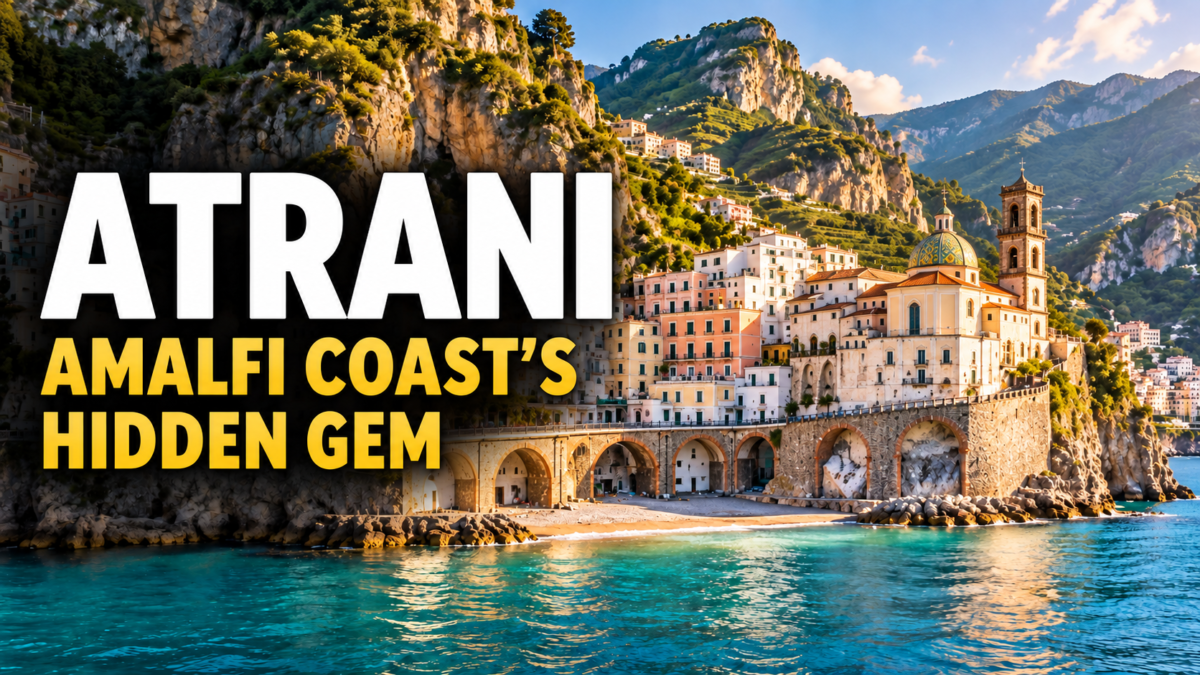
Some places on the Amalfi Coast invite you to slow down, take a seat in a small square and watch village life unfold. Atrani is one of them.
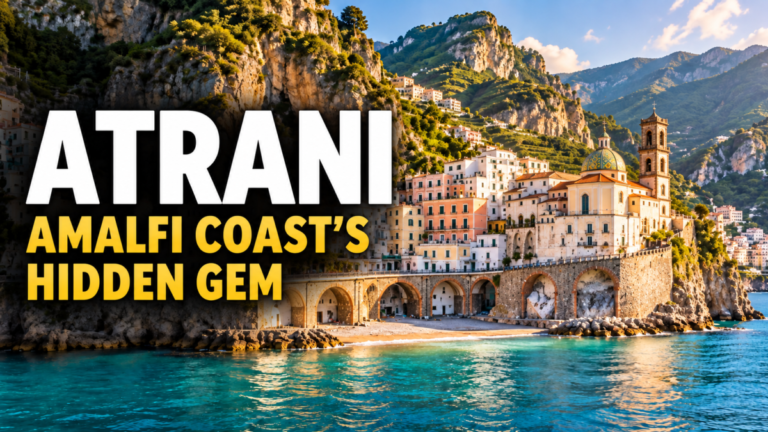
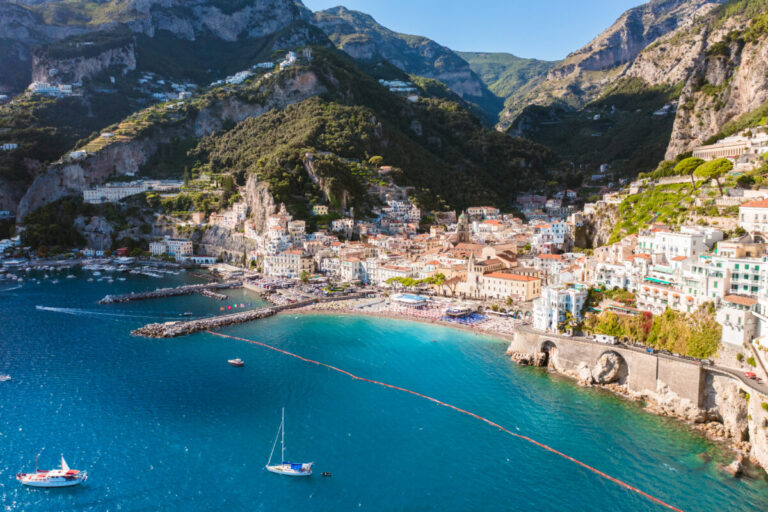
Nestled between steep hills and the Mediterranean Sea, this compact coastal village is a maze of pastel-coloured houses, sheltered passageways and staircases connecting the beach with the streets above. Just a short walk from Amalfi, it combines a remarkable historical heritage with the welcoming atmosphere of a seaside community.
Whether you visit for a summer swim, a seafood lunch or an evening beneath the Christmas lights, Atrani deserves a place on your itinerary. For guests staying at Villa Amalia in Cava de’ Tirreni, it makes a rewarding day trip along the Amalfi Coast.
A Small Village with an Important History
Atrani’s origins remain uncertain. The historical account published by the municipality identifies a letter from Pope Gregory the Great, dated 596, as the earliest documentary evidence of the settlement. The origin of the village’s name is also debated, with several interpretations proposed over time.
What is clearer is Atrani’s close relationship with medieval Amalfi. During the period of the Duchy of Amalfi, the village was home to influential noble families and played a part in the political life of the territory.
According to the municipal historical account, the people of Amalfi and Atrani shared the right to elect or depose their rulers. Atrani’s small size should therefore not be mistaken for historical insignificance: it belonged to the political heart of a maritime power whose connections extended across the Mediterranean. (comune.atrani.sa.it)
The European University Centre for Cultural Heritage also describes Atrani as a residence of Amalfi’s nobility and highlights the connection between the Church of San Salvatore de’ Birecto and the investiture of Amalfi’s rulers.
Exploring Amalfi and Atrani together offers complementary perspectives on this shared history: the commercial and monumental character of Amalfi, alongside the residential and ceremonial importance of its smaller neighbour. (unescoamalficoast.it)
San Salvatore de’ Birecto and the Dukes of Amalfi
The Church of San Salvatore de’ Birecto, overlooking the village square, is an essential stop for anyone interested in Atrani’s past.
The municipality dates its construction to the tenth century. Its name is traditionally associated with the birecto, the ceremonial headwear symbolising ducal authority, and historical accounts connect the church with the investiture of the Dukes of Amalfi.
This association gives the square a deeper significance. Today, visitors come here for coffee, conversation and a moment of shade; centuries ago, the church was linked to ceremonies expressing the authority of Amalfi’s rulers.
Among the artistic treasures associated with the building are bronze doors dated 1087, reflecting the prestige of medieval patronage in the Amalfi area. Visitors wishing to explore the interior should check opening arrangements locally. (comune.atrani.sa.it, comune.atrani.sa.it)
Things to Do in Atrani: Santa Maria Maddalena and the Historic Centre
The Collegiate Church of Santa Maria Maddalena is one of Atrani’s most recognisable landmarks.
Italy’s General Catalogue of Cultural Heritage dates its foundation to 1274, on the remains of a medieval fortification, and records later alterations and extensions during the Baroque period.
Its position above the coast makes it an important feature of the village skyline. The surrounding streets reveal how churches, homes and pedestrian routes developed within a narrow space between the mountains and the sea.
Other historic religious buildings include Santa Maria del Bando and San Michele Fuori le Mura, offering further opportunities to explore Atrani’s architectural heritage when access is available. (catalogo.beniculturali.it)
Beyond individual monuments, much of Atrani’s appeal lies in the experience of walking through it. A staircase leads beneath an arch, a passage opens onto a small courtyard, and a gap between buildings reveals the sea.
This close relationship between settlement and landscape is part of the wider cultural value of the Amalfi Coast, inscribed on the UNESCO World Heritage List in 1997. Atrani offers an intimate setting in which to appreciate how generations of inhabitants adapted their buildings and daily lives to the coastline. (whc.unesco.org)
Atrani Through the Eyes of M. C. Escher
Atrani also has a place in twentieth-century art.
The Dutch artist Maurits Cornelis Escher depicted the village in his 1931 lithograph Atrani, Coast of Amalfi. Its architecture later appeared in his celebrated Metamorphosis works.
The museum Escher in The Palace highlights the importance of Santa Maria Maddalena and its distinctive bell tower within these compositions. Atrani’s overlapping buildings, changing levels and unexpected perspectives offered rich material for an artist fascinated by geometry and transformation.
Knowing this connection adds another dimension to a visit. As you walk, notice how stairways, rooftops and façades fit together, creating compositions that shift with every turn. (escherinhetpaleis.nl, escherinhetpaleis.nl)
Atrani Beach: A Seaside Escape Steps from the Village
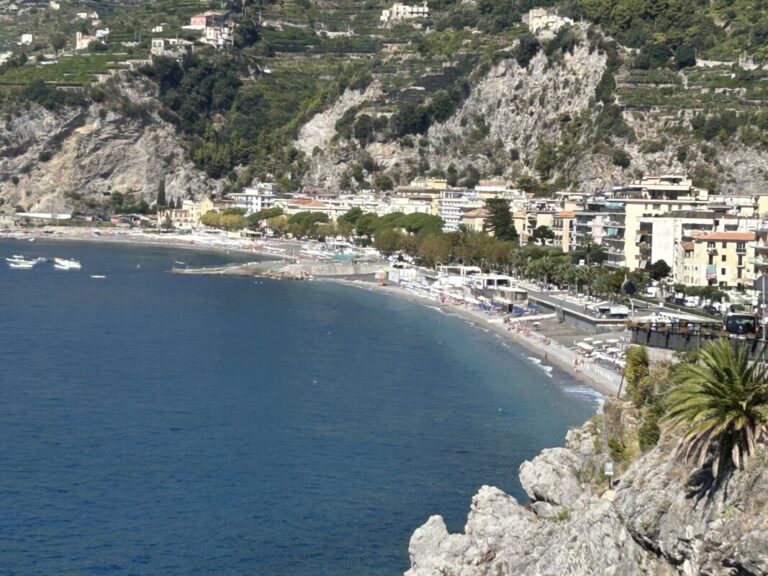
Atrani’s small beach sits directly in front of the village, making it easy to combine swimming with sightseeing or a leisurely lunch.
The municipal tourism website describes a shoreline of sand and fine gravel, with an equipped beach area towards the west and a public section towards the east.
Its proximity to the centre is particularly convenient for families and for visitors who prefer to keep restaurants and other amenities close at hand. Sea conditions should always be assessed on the day. (atraniturismo.it)
The beach’s compact size is part of its character, although space can be limited during the busiest summer periods. Arriving early is a sensible choice, and anyone wishing to use sunbeds and umbrellas should check availability and booking arrangements in advance.
For a balanced summer itinerary, spend the morning exploring the village, enjoy lunch nearby and leave time for a swim. Atrani makes it possible to combine these experiences without travelling between separate destinations.
Christmas Lights in Atrani
Atrani is also worth discovering beyond the summer season.
During the Christmas period, illuminations bring a different atmosphere to its arches, staircases and small squares. The closely grouped houses already resemble the setting of a traditional Italian nativity scene, and evening lighting emphasises this distinctive character.
For Christmas 2025, the municipality documented the “Atrani è Luce” project, featuring illuminated village spaces and musical events. (comune.atrani.sa.it)
Visitors planning a winter trip should consult the programme for the relevant year on the municipal website or Atrani Turismo. Switch-on dates, evening schedules and accompanying events can change.
A pleasant approach is to arrive before sunset, explore the village in daylight and stay to see the lights after dark. Dinner nearby can complete the evening, provided restaurant opening times and the return journey have been arranged.
Where to Eat in Atrani
A meal in Atrani is an opportunity to enjoy the seafood traditions of the Amalfi Coast. Two addresses to consider are ’A Paranza and Le Arcate, each offering a different setting.
’A Paranza
Located within the village, ’A Paranza focuses on seafood in an intimate setting. The restaurant emphasises its ingredients and preparations designed to preserve their flavour, and it is included in the Michelin Guide selection.
It is an option for visitors who would like to make lunch or dinner a central part of their visit. When booking, ask about the day’s dishes and available seafood. (ristoranteparanza.com, guide.michelin.com)
Le Arcate
For a meal close to the beach, Le Arcate offers a waterfront setting and a menu rooted in the cooking traditions of the Amalfi Coast.
Its official website describes a family hospitality tradition and dishes such as spaghetti with clams. The location makes it an option for a lunch after swimming or a relaxed meal overlooking the sea. (learcateatrani.it)
For both restaurants, check current menus, prices and opening days before visiting, particularly outside the main holiday season. Reservations are advisable during busy periods.
How to Reach Atrani from Villa Amalia
Villa Amalia is located in Cava de’ Tirreni. The most suitable way to reach Atrani depends on the season, your preferred departure time and whether you plan to stay into the evening. (amalficoastresort.it)
By Ferry to Amalfi, Followed by a Short Walk
When suitable ferry services are operating, travelling by sea is an appealing option.
From Villa Amalia, first arrange transport to a convenient departure point in Salerno or Vietri sul Mare. Check the available services to Amalfi for your travel date, then continue on foot to Atrani.
The local tourism website describes the walk from Amalfi as taking approximately ten minutes. Allow additional time from the landing point, especially if travelling with children or stopping along the way. (travelmar.it, travelmar.it, atraniturismo.it)
This option adds coastal views from the water to your day out. Before booking, consult the Travelmar timetable, check the final return departure and review any weather-related service updates.
By Car or Private Transfer
The coastal road route leads through Vietri sul Mare and follows the SS163 towards Amalfi, passing Cetara, Maiori and Minori before reaching Atrani.
For visitors planning dinner or an evening visit to the Christmas lights, a private transfer with a prearranged return can be a practical choice.
Those driving can consider the Luna Rossa car park, which Atrani’s tourism website identifies as an option for reaching the village on foot. Check current access arrangements, availability and charges before departure.
Journey times can vary considerably with traffic, so leave flexibility in your plans. (atraniturismo.it)
By Bus
Public transport is another possibility. After reaching a suitable stop on the coastal route, visitors can use the SITA Sud services on the Salerno–Maiori–Amalfi line.
Check the current timetable and the appropriate stop for Atrani on the official SITA Sud website, paying particular attention to return services. (sitasudtrasporti.it)
Planning Your Day Trip to Atrani
Atrani is best enjoyed with a little time to spare.
In summer, combine a walk through the historic centre with a seafood lunch and a few hours on the beach. If the churches are open, step inside and discover the buildings that connect the village to the history of medieval Amalfi.
In winter, consider visiting Amalfi during the afternoon before continuing to Atrani around sunset, when Christmas illuminations are scheduled.
During your stay at Villa Amalia – Amalfi Coast Resort, Atrani offers an excursion bringing together history, architecture, local food and the sea. Its small scale makes these experiences feel closely connected: the beach lies beside the village, the square opens towards the waterfront, and centuries of history remain woven into the streets.