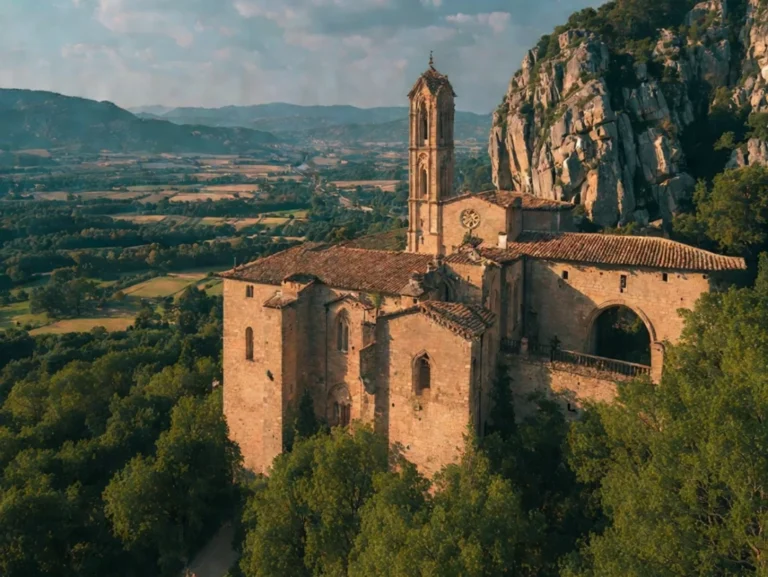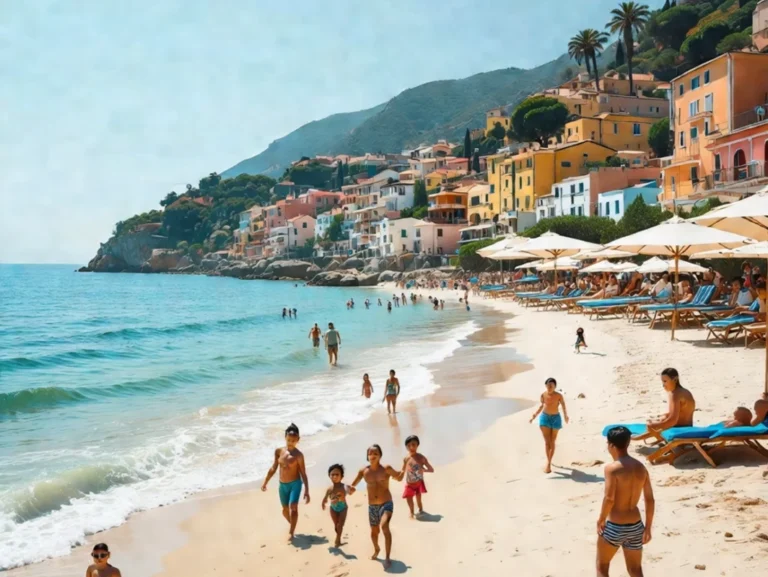

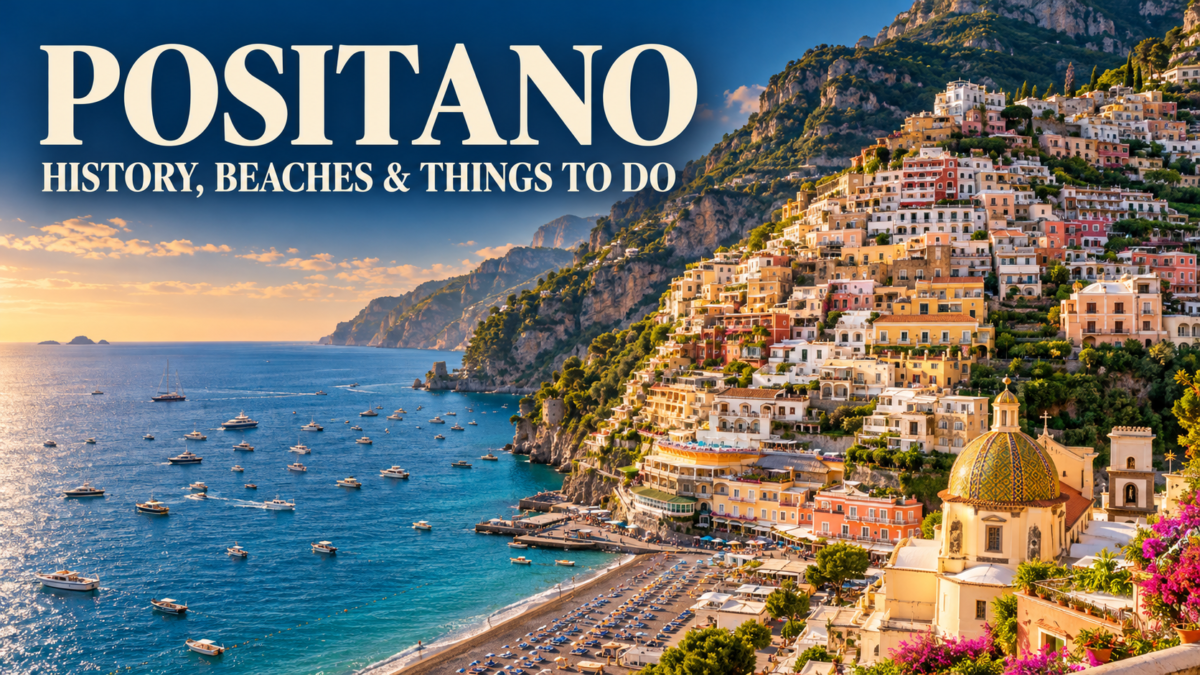
Positano reveals itself through the arrangement of its houses: rising from the sea, gathering around the church’s colourful tiled dome and continuing towards terraces, gardens and neighbourhoods that seem suspended above the gulf.
Seen from a boat, it resembles an amphitheatre of colours. Explored on foot, it becomes a succession of stairways, alleyways and passages where the view changes at every turn. A terrace appears between two buildings, a staircase leads towards the beach, and a small workshop reveals a local craft tradition.
Behind this celebrated image lies a history of Roman villas, maritime trade, religious devotion, emigration and encounters with artists and travellers. Discovering it allows you to appreciate Positano beyond its most familiar photograph.
For guests staying at Villa Amalia in Cava de’ Tirreni, Positano deserves a full day, with time for the sea, culture and the pleasure of exploring on foot.
Where Is Positano?
Positano is in Campania, in the province of Salerno, on the southern side of the Sorrento Peninsula. It lies in the western part of the Amalfi Coast, along the route connecting Amalfi with the Sorrento area.
The land rises steeply from the coast towards the Lattari Mountains. This proximity between mountains and sea shapes the town: there is little flat ground, buildings occupy different elevations, and a dense network of pedestrian routes connects them.
Positano forms part of the cultural landscape of the Amalfi Coast, inscribed on the UNESCO World Heritage List in 1997. The area’s significance also comes from the way communities adapted to a steep, complex environment through settlements and agricultural terraces. Source: UNESCO, Costiera Amalfitana.
When Was Positano Founded?
There is no certain founding year for the town we know today. It is more accurate to distinguish the ancient use of this coastline from the later development of the settlement.
An important piece of evidence dates from Roman times: by the end of the first century BC, the bay was home to a luxurious seaside villa. Wealthy Romans already appreciated this landscape as a place for leisure.
The residence documents an ancient history, although it does not mean that a town with today’s form and organisation already existed. The settlement developed later, its life intertwined with fishing, navigation and the history of the Amalfi area. Sources: Roman Archaeological Museum of Positano, UNESCO Amalfi Coast, History of Positano.
Medieval Positano and Its Relationship with Amalfi
During the Middle Ages, Positano belonged to the Duchy of Amalfi and shared in the history of a territory connected to Mediterranean trade.
An important distinction should be made: Positano was not one of the four Maritime Republics. It belonged to the area over which Amalfi exercised its power.
For these coastal communities, the sea was an essential means of communication. It allowed goods and people to move between places that were separated by mountains and demanding routes overland. Navigation also encouraged the exchange of ideas, objects and cultural influences. Source: UNESCO Amalfi Coast, Regional History.
The town’s religious history is connected to the Benedictine Abbey of Santa Maria, probably founded in the second half of the tenth century. A document from the late eleventh century records permission for the monastery’s abbot to navigate freely in the waters of the Duchy of Sorrento. Source: Municipality of Positano, Church of Santa Maria Assunta.
From Maritime Trade to Emigration
Positano experienced different economic fortunes. During the eighteenth century, maritime trade contributed to a period of prosperity. In the nineteenth century, changes in trading routes and the economy brought new difficulties.
Between the late nineteenth and early twentieth centuries, many residents left in search of opportunities elsewhere. Emigration deeply affected certain neighbourhoods, including Liparlati, also remembered as the “dead town” because of the homes left empty.
This history reveals Positano as a place shaped by work, departures and change long before it became an international destination. Sources: Positano Historical Guide, Municipality of Positano, Neighbourhoods.
Artists, Writers and the Growth of International Tourism
During the twentieth century, Positano attracted painters, writers and people seeking somewhere to live and work. In the years of totalitarian rule, it also welcomed intellectuals and artists in exile, becoming a meeting place for different cultures and experiences. Source: State Archives of Salerno, Travellers and Tourism.
Its reputation grew further after the Second World War. Le Sirenuse opened in 1951, transforming the Sersale family home into a hotel. In 1953, John Steinbeck visited Positano and helped introduce its appeal to an international audience.
The image of a creative, welcoming Mediterranean village became increasingly associated with travelling in Italy. Source: Le Sirenuse, Hotel and Town History.
Geology and Landscape: How the Vertical Town Took Shape
Positano’s form begins with the mountains. Its territory is characterised by steep limestone slopes, valleys and short stretches of coastline where beaches have formed.
The rocks have an ancient marine sedimentary origin, followed by geological processes that raised and shaped the mountains. Water cut into the slopes and carried material downhill, while the sea reworked sediments along the shore.
More recent deposits, including volcanic material, locally cover the limestone. The Roman villa’s history shows how an eruption far from the bay could still affect this landscape. Sources: Municipality of Positano, Woodland and Pasture Management Plan, Roman Archaeological Museum.
For visitors, this geography has practical consequences: two places that appear close on a map may be separated by a long staircase, while accommodation with a spectacular view may sit well above the sea.
How Positano Was Built
The town developed by adapting to its slopes and available space. Buildings occupy different elevations, overlook terraces and connect through routes that follow the terrain.
The description “vertical town” reflects the experience of visiting. In Positano, you continually climb and descend, moving between open panoramas and intimate pedestrian streets.
The lower area around Piazza dei Mulini, the church and Spiaggia Grande concentrates many businesses and much of the visitor activity. Higher up, other neighbourhoods offer different perspectives.
To appreciate the town, combine its busiest places with a few detours, allowing enough time to explore comfortably. A pause also offers an opportunity to notice how houses, gardens and passages fit into the hillside.
The Church of Santa Maria Assunta
The majolica-tiled dome of the Church of Santa Maria Assunta is one of Positano’s symbols. Its colours rise above the buildings, helping you find your bearings when viewing the town from the beach or sea.
The church’s history is connected to the former Benedictine monastery. Its present appearance largely reflects work carried out between 1777 and 1782, followed by its consecration in 1783.
Inside is the venerated icon of the Virgin Mary. According to legend, a ship carrying the image heard a voice repeating “Posa, posa”, calling on the sailors to stop here. The story connects religious devotion with a popular explanation of the town’s name, although it should be distinguished from a historically proven origin. Source: Municipality of Positano, Church of Santa Maria Assunta.
A visit fits easily into a walk towards the beach, respecting any services taking place.
The Roman Archaeological Museum: A Discovery Beneath the Centre
Beneath the Santa Maria Assunta complex lies one of Positano’s most remarkable historical sites: the remains of a Roman villa, accessible through the MAR, the Roman Archaeological Museum.
The visitor route reveals a richly decorated room with vivid frescoes, stucco details and evidence of life within the residence. The paintings belong to the style known as the Fourth Pompeian Style.
The villa was buried by material associated with the eruption of Mount Vesuvius in AD 79. Its rediscovery revealed a chapter of Positano’s history long before the present town developed.
Here, history unfolds below ground: beneath modern streets and buildings survive Roman rooms and later medieval layers. Source: MAR Positano, The Villa.
Before visiting, check admission times, availability and booking arrangements.
Neighbourhoods and Places to Explore on Foot
The Centre and Spiaggia Grande
The descent from Piazza dei Mulini towards the church and sea follows one of Positano’s liveliest routes. Shops selling clothing and ceramics, along with cafés and restaurants, line the walk.
Once you reach the beach, turn around: the town rises in a continuous sweep of buildings up the mountainside. It is one of the best viewpoints for understanding its layout.
Fornillo
Fornillo offers another part of town to explore, with stairways, homes and glimpses of the sea. The neighbourhood’s paths also lead past the small Church of Santa Margherita.
The coastal walk connecting the Spiaggia Grande area with Fornillo Bay is a pleasant way to move away from the busiest part of the centre. Sources: Municipality of Positano, Neighbourhoods, Fornillo Beach.
Montepertuso
Higher up lies Montepertuso, recognisable for the large opening in the rock from which the village takes its name.
The views broaden here, and the visit takes on a different pace. Local tradition connects the pierced mountain with a religious legend, commemorated during the celebrations of Our Lady of Grace on 2 July. Source: Municipality of Positano, Montepertuso.
Nocelle
Nocelle is a small hillside village associated with hiking routes and the Path of the Gods. Terraces and viewpoints reveal the coastline from above, while family-run accommodation offers the possibility of staying close to the mountains.
The pedestrian connection with the lower town involves a great many steps. Reaching Nocelle and returning to the sea therefore requires careful planning of your route and transport. Source: Municipality of Positano, Nocelle.
Positano’s Beaches
The beaches have different personalities, but all share the presence of mountains close to the water. Space is limited, and your choice will also depend on access, preferred facilities and the time available.
Spiaggia Grande: The Famous View
Spiaggia Grande, also called Marina Grande, is Positano’s main beach. The town rises behind it, with boat landing points nearby.
It is the most convenient choice for combining the historic centre, lunch and a few hours by the sea. There are beach clubs and a public section, with a lively atmosphere, particularly during summer. Source: Guide to Positano’s Beaches.
Fornillo: A Bay Reached by a Coastal Walk
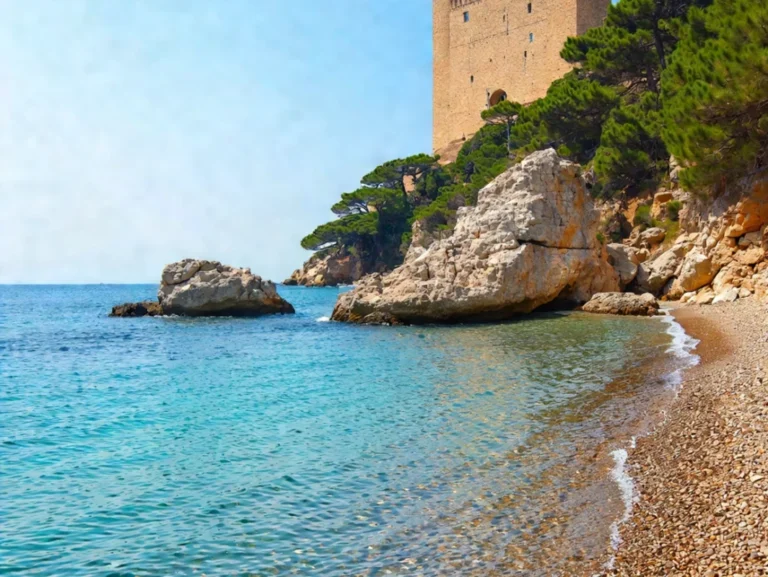
Fornillo has a pebble-and-gravel shoreline, with beach clubs, dining options and public sections. Its position away from the main beach gives it a more secluded setting.
You can walk there from the waterfront in around ten minutes, following the coastal path. The actual time depends on where you start and how often you stop. Sources: Italia.it, Positano, Municipality of Positano, Fornillo.
Arienzo: A Day Between Beach and Cliffs
Arienzo lies east of the centre. Access from the road involves a long staircase, while some beach services offer boat transfers.
Consider it if you would like to devote a substantial part of the day to the beach. Book ahead and check what your chosen service includes. Source: Positano.com, Beach Clubs and Access to Arienzo.
Laurito: A Small Cove Outside the Centre
Laurito is a small beach beneath the cliffs, reached by steps or through available boat services.
Dining facilities make it possible to combine a swim with lunch close to the water. Before setting off, confirm access, reservations and any return boat arrangements. Source: Guide to Positano’s Beaches.
For all beaches, remember that an easy descent can become a demanding climb on the way back. Suitable footwear and an assessment of the elevation changes will help you plan the day.
Positano from the Sea and the Li Galli Islands
A short boat trip reveals features that remain hidden from land: the relationship between cliffs and buildings, small inlets and the succession of headlands.
Offshore lies the Li Galli archipelago, comprising Gallo Lungo, La Rotonda and Isola dei Briganti, also known as Castelluccia. The islands are traditionally associated with the myth of the sirens and have connections with the world of dance, particularly Léonide Massine and Rudolf Nureyev.
The islands are privately owned, so a boat trip nearby does not necessarily include permission to land. Agree on the route, stops and swimming opportunities with your operator, taking account of conditions and local regulations. Source: Guide to the Li Galli Islands.
The Path of the Gods
The Path of the Gods is one of the best-known ways to experience the Amalfi Coast from above. The most popular route connects Bomerano, in the municipality of Agerola, with Nocelle, part of Positano.
Along the trail, agricultural landscapes, Mediterranean vegetation and coastal views reveal how closely these communities are connected to the mountains.
The municipality classifies it as an E-category hiking route. Wear appropriate footwear, carry water and assess your abilities before starting. The trail to Nocelle and the subsequent descent towards Positano are separate stages to consider when planning. Sources: Municipality of Positano, Path of the Gods, Route Guide.
For guests leaving from Villa Amalia, it is preferable to dedicate a specific day to the hike, organising transport to Bomerano and the return journey separately.
Positano Fashion and Craftsmanship
Positano’s identity is also expressed through its workshops. Moda Positano, or Positano fashion, developed particularly from the late 1950s, responding to demand for clothing suited to seaside life.
Linen, cotton, lace and lightweight designs helped establish a recognisable style associated with the freedom of a Mediterranean holiday. Handmade sandals, including custom-made pairs, and ceramics form part of this craft tradition.
Visiting the shops provides an opportunity to learn about materials, production methods and where products come from. A purchase can become an encounter with someone continuing a local craft. Source: Municipality of Positano, Craftsmanship and Moda Positano.
What to Eat in Positano
Local cooking belongs to the Campanian and Mediterranean traditions: fish, pasta, seasonal vegetables, citrus fruits and produce from the surrounding hills.
Connections with the Lattari Mountains also bring dairy products and ingredients reflecting the nearby countryside. A memorable lunch might centre on seafood or a simple dish of vegetables, pasta or cheese. Source: Italia.it, Positano.
Choose according to the experience you want: lunch beside the beach, a restaurant stop during your walk or a panoramic dinner that becomes the focus of the evening.
Restaurants to Consider
Da Vincenzo
On Viale Pasitea, Da Vincenzo is an option for cooking rooted in Campanian tradition. Its location makes it suitable for an itinerary that includes the streets above the waterfront centre. Sources: Official Website, Michelin Guide.
La Sponda
La Sponda, inside Le Sirenuse, combines Mediterranean cuisine with views over the town. Its candlelit dining room makes it an option for a special dinner.
Before booking, consult current menus and access conditions, including arrangements for guests who are not staying at the hotel. Sources: La Sponda, Booking Information.
Zass
Zass, at Il San Pietro di Positano, serves contemporary Mediterranean cuisine in a panoramic setting outside the central town.
Plan ahead, allowing time for the journey and for enjoying dinner. Source: Michelin Guide, Zass.
Al Palazzo
In central Positano, Al Palazzo, at Palazzo Murat, offers a setting shaped by the gardens and architecture of a historic residence. It may appeal to visitors seeking a meal surrounded by greenery, close to the town’s pedestrian routes. Source: Palazzo Murat.
Reservations are advisable during busy periods. Prices, menus, seasonal openings and conditions can change, so check directly with the restaurant.
Where to Stay in Positano
Positano offers hotels, guesthouses, bed and breakfasts, apartments and villas. When choosing, consider elevation as well as location.
Accommodation near the sea can make access to boats and the beach easier. A property higher up may offer wide views but require more travelling on foot or by transport. Montepertuso and Nocelle offer a different type of stay, centred on hillside villages and walking routes.
Before booking, ask:
- How many steps separate the entrance from a road accessible to vehicles.
- How luggage is handled.
- Whether parking or transfers are available.
- How long the actual journey to the beach and centre takes.
Representative hotels include Le Sirenuse, closely associated with Positano’s hospitality history; Palazzo Murat, a historic residence with gardens in the centre; and Il San Pietro di Positano, in a panoramic setting outside the centre, with access to the sea by a lift carved into the rock. They illustrate different types of stay, to consider according to your budget and preferences. Sources: Le Sirenuse, Palazzo Murat, Il San Pietro.
Visitors planning to explore several destinations can also choose a base outside the coastal towns. Villa Amalia, in Cava de’ Tirreni, allows you to include Positano among your day trips, arranging the journey around available connections and the time you wish to spend there.
How to Spend One Day in Positano
A first visit can begin in the lower town, particularly convenient for visitors arriving by ferry.
In the morning, walk from the beach towards the Church of Santa Maria Assunta and visit the MAR, booking your preferred admission time. Continue through the central streets and shops.
For lunch, choose between staying close to the sea and heading uphill to a restaurant along the town’s streets.
In the afternoon, spend a few hours at the beach or walk to Fornillo. Alternatively, choose a boat excursion, leaving enough time for your return.
Towards evening, a viewpoint or a stop on the waterfront allows you to watch the changing light on the houses. If returning by sea, however, plan the day around the last suitable departure.
Montepertuso, Nocelle and the Path of the Gods deserve more time. Including them all in a first visit can leave little opportunity to enjoy the town itself.
How to Reach Positano from Villa Amalia
By Sea from Salerno or Vietri sul Mare
From Villa Amalia, you can reach a departure point in Salerno or Vietri sul Mare and continue towards Positano using the services operating on your chosen date.
This allows you to see the coast from the water and arrive in the lower part of town. Some journeys may require a change in Amalfi. Before purchasing tickets, check the complete itinerary, including connections and the return journey.
Always consult the operator’s current timetable. Confirm the exact pier and check for notices concerning sea and weather conditions. Source: Travelmar, Timetables and Fares.
By Car or Private Transfer
The coastal route from Cava de’ Tirreni passes through Vietri sul Mare and continues along the SS163, travelling through the coastal towns towards Amalfi, Praiano and Positano.
The road offers scenic views, but bends, traffic and finding parking can lengthen the journey. Allow extra time and check any driving restrictions applying during your visit.
A private transfer with a prearranged return can be practical if you would like to stay for dinner or avoid managing parking.
By Bus
One option is to reach Amalfi using coastal services from Salerno or Vietri, then continue on the Amalfi–Positano–Sorrento route.
Check connections and your arrival stop: buses serve the road network above the waterfront, and you may need to walk downhill towards the centre and sea. Source: SITA Sud, Amalfi Coast Services.
Positano has no railway station. The final part of the journey must be made by road or sea.
When to Visit Positano
Spring and early autumn are worth considering for a visit combining walks, cultural attractions and time outdoors. Positano can still be very busy during these periods.
Summer suits visitors who want to focus on the sea and evening life, booking beach clubs, restaurants and transport in advance.
In winter, the town changes pace. Some businesses and accommodation close seasonally, while sea connections may be reduced or suspended. Visiting during this period requires more careful checking of available services.
Whatever the season, Positano is best enjoyed with time for pauses. Its beauty emerges from the relationship between short distances and steep changes in elevation, between life by the sea and the villages above.
During a stay at Villa Amalia, a day here can introduce you to many histories: Romans who chose the bay for leisure, sailors, residents who left to seek opportunities elsewhere, and craftspeople who continue to shape its identity. Their stories meet among the houses, stairways and sea of the vertical town.