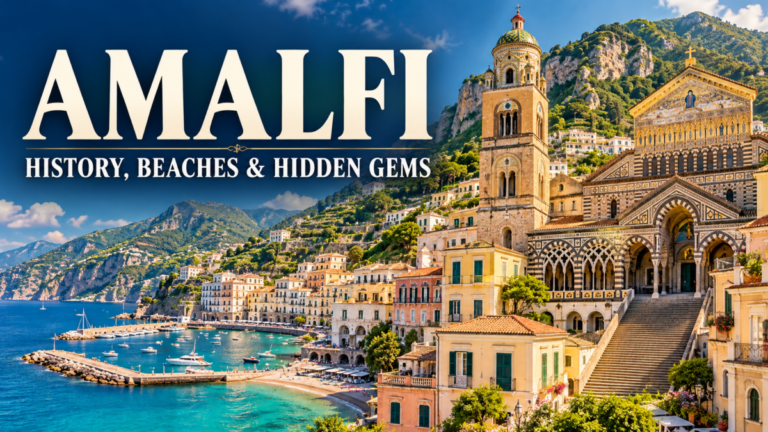

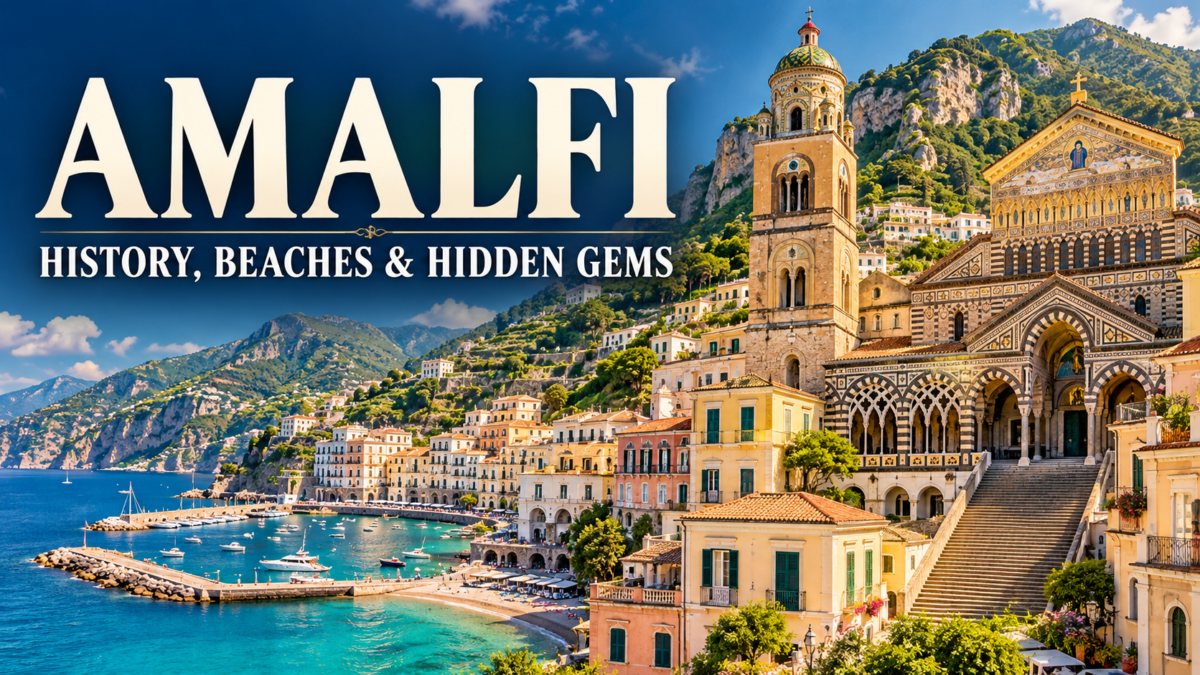
Arriving by sea, Amalfi appears nestled between two worlds: the Gulf of Salerno in front and the mountains behind, carved by valleys and shaped by agricultural terraces. Houses climb the slopes, the bell tower rises above the rooftops, and the streets of the historic centre lead to a square dominated by the Cathedral’s grand staircase.
It is a landscape that invites you to pause, but also to look beyond first impressions. This small town was once a leading power in the medieval Mediterranean, building trading relationships with distant ports, developing its own maritime legal tradition and welcoming artistic influences from East and West.
Visiting Amalfi means exploring this history while enjoying a town best discovered on foot: through alleyways, former paper mills, lemon groves, beaches and restaurants that express the flavours of the region. For guests staying at Villa Amalia in Cava de’ Tirreni, it is one of the most rewarding day trips.
When Was Amalfi Founded?
Amalfi’s origins cannot be traced to a definite founding year. The settlement emerged during late antiquity, although its earliest history remains partly uncertain. The origin of its name is also debated.
Alongside the historical accounts, there is a legend: Amalfi was a nymph loved by Hercules, who chose this place for her burial because its beauty was worthy of his beloved. It is an evocative story that belongs to the town’s mythology.
A firmer historical reference is the existence of a bishopric as early as 596, evidence of an organised community before Amalfi’s great maritime expansion. Source: History of Amalfi.
To understand the town’s rise, imagine the sea as a road. In a mountainous landscape where travelling overland was difficult, sailing opened routes to distant markets and communities. Amalfi’s seemingly isolated position became an advantage.
Amalfi and the Four Maritime Republics
Amalfi belongs to the group of four Maritime Republics traditionally celebrated alongside Pisa, Genoa and Venice. Its golden age began earlier than that of many other Italian trading powers.
The key date is 1 September 839, when Amalfi separated from the Duchy of Naples and began a period of self-government. Its political structure changed over time: initially governed by elected counts, it later came under prefects and dukes. The term “Maritime Republic” therefore encompasses a political history that also included government as a duchy. Source: Municipality of Amalfi, Political Organisation.
Between the ninth and eleventh centuries, Amalfi built a network of relationships connecting the Latin, Byzantine and Arab worlds. Amalfitan merchants maintained trading establishments, homes and facilities supporting their businesses and communities in Mediterranean ports.
The town’s strength depended on ships, but also on negotiation, knowledge of different languages and customs, and the ability to maintain relationships and organise trade. This openness helps explain the Eastern influences still visible in local art and architecture. Source: Amalfi’s History, UNESCO Amalfi Coast.
One of the most important legacies of this civilisation is the Tabula de Amalpha, also known as the Amalfitan Tables: a collection of rules and customs governing navigation, relationships between seafarers and commercial activities. It is a major contribution to the medieval tradition of maritime law. Source: Visit Amalfi, Maritime Republic Itinerary.
The Decline of Amalfi’s Maritime Power
The loss of independence was gradual. The Norman conquest in 1131 and subsequent attacks by Pisa marked decisive stages in the decline of Amalfi’s power.
In November 1343, a maritime disaster severely damaged the waterfront and harbour facilities. This event is sometimes presented as the sudden end of the Republic, although its political independence and commercial supremacy had already been undermined long before. Sources: History of Amalfi, Marina Coppola, History of the Town.
Over the following centuries, the town continued to rely on manufacturing, agriculture and trade. Its future as a visitor destination developed much later, when the Amalfi Coast’s landscape began attracting travellers, writers and artists.
Geology and Landscape: Why Does Amalfi Look This Way?
Amalfi’s beauty also comes from the structure of its landscape. The town occupies the mouth of a valley on the southern slopes of the Lattari Mountains, where the mountains approach the sea, leaving little flat land.
The area’s rocks are predominantly limestone and dolomite: sedimentary rocks of ancient marine origin, later uplifted and shaped by movements in the Earth’s crust and erosion. Over time, water carved valleys and channels through the rock, helping create the steep landscape surrounding the town. Source: European University Centre for Cultural Heritage, Building Techniques of the Amalfi Coast.
This setting explains much of what visitors encounter: steep streets, stairways, small beaches enclosed by rocky cliffs, and the rapid transition from the waterfront into a valley landscape.
Behind the town flows the Canneto stream. Its waters once played an essential economic role, powering mills and paper factories through a system of channels. Amalfi’s urban history therefore owes as much to the water descending from the mountains as to the sea. Source: Paper Museum Foundation.
How the Town Was Built
Amalfi developed by adapting to the space available. Buildings cluster along the valley and climb the slopes, while alleyways, covered passages and staircases connect different levels. Houses often appear stacked above one another, with arches and vaults adding further layers to the townscape.
Walking through the centre reveals this arrangement gradually. A small passage off the main street may lead to a quieter corner, a staircase, a courtyard or an unexpected view.
On the hillsides, generations of work created agricultural terraces supported by retaining walls known as macere, making steep land suitable for cultivation. Lemon groves and vegetable gardens form part of a productive landscape built and maintained over centuries.
This relationship between nature, settlements and agriculture contributes to the significance of the Amalfi Coast, inscribed on the UNESCO World Heritage List in 1997. Sources: UNESCO, Terraces and Landscape.
Amalfi Cathedral: A Monumental Complex to Explore
The Cathedral of Saint Andrew the Apostle is Amalfi’s most recognisable landmark. Its staircase creates a theatrical perspective, raising the building above the daily activity of the square.
To appreciate it fully, think of it as a group of buildings shaped by successive transformations. The complex includes the Cathedral, the ancient Basilica of the Crucifix, the Cloister of Paradise and the Crypt of Saint Andrew.
The façade also has a less obvious history: the present front was built during the nineteenth century, following the collapse of 1861, and completed in 1891. Its design reinterprets medieval architectural forms. Beside it stands the bell tower, built between the twelfth and thirteenth centuries, with interlacing arches and colourful ceramic decoration at the top. Source: Visit Amalfi, Piazza Duomo.
The Cloister of Paradise
Built between 1266 and 1268 as a burial place for Amalfi’s nobility, the Cloister of Paradise is one of the town’s most atmospheric spaces.
Slender columns, interlacing arches and a central garden create a peaceful setting. Along the galleries, sarcophagi and decorative fragments reveal how objects and materials from different periods became part of the complex’s history. Source: Diocesan Museum of Amalfi.
The Crypt of Saint Andrew
The Crypt houses the relics of Saint Andrew, brought to Amalfi from Constantinople on 8 May 1208 through Cardinal Pietro Capuano. It is both the heart of the town’s religious devotion and a space of considerable artistic interest. Source: Diocesan Museum, The Crypt.
The Basilica of the Crucifix
The Basilica of the Crucifix forms the oldest part of the episcopal complex and houses the Diocesan Museum. A visit reveals its architectural layers and introduces part of the town’s artistic and religious heritage. Source: Diocesan Museum.
Allow around an hour for the monumental complex, or longer for a more detailed visit. Check opening times, admission arrangements and visitor access before travelling, as religious services may affect visits.
The Arsenal of the Republic
Just a short walk from the sea, the Arsenal offers a tangible connection to Amalfi’s naval power. Warships were built within its stone halls, an undertaking that required skilled workers, materials and technical knowledge.
Today, the building houses the Museum of the Compass and the Maritime Duchy, dedicated to the town’s history and navigation. It is particularly worthwhile for visitors who want to connect the monuments of the centre with Amalfi’s commercial and political past. Sources: Official Arsenal Website, Municipality of Amalfi.
The compass tradition is also associated with Flavio Gioia, commemorated by a monument in town. However, his identity as its inventor belongs to tradition rather than a historically established biography. Source: History of Amalfi.
The Paper Museum and the Tradition of Bambagina
Following the main streets inland brings you to the Paper Museum on Via delle Cartiere. It is one of the most interesting places to discover Amalfi’s working history.
Local papermaking has medieval roots and developed through access to water and contacts with the eastern Mediterranean. Paper was made using fibres obtained from rags, through a process requiring skill and several stages of production.
The museum preserves machinery and spaces used in traditional papermaking, offering visits with demonstrations and activities devoted to handmade paper. It is also worth considering with children, particularly when choosing one of the practical experiences available. Sources: Paper Museum Foundation, Paper Museum, Visits and Activities.
A sheet of Amalfi paper makes a souvenir connected to a specific craft tradition: light enough to carry home, yet rich in the town’s history.
From the Valley of the Mills to the Valley of the Ferriere
Behind the town, the landscape changes. Routes towards the Valley of the Mills and the Valley of the Ferriere lead through vegetation, agricultural terraces, waterways and the remains of former industries.
The ruins of paper mills and ironworks remind visitors that these places, now enjoyed by walkers, were once working landscapes. The valley’s distinctive microclimate also supports vegetation different from that found along the waterfront. Source: Visit Amalfi, Valley of the Ferriere.
A walk through the lower valley and a hike towards the nature reserve require different amounts of time and preparation. Choose your route beforehand, check whether trails are open and confirm access arrangements for protected areas.
Visitors who devote the morning to the valley can spend the afternoon in the historic centre. On a first visit to Amalfi, a shorter walk offers an introduction to this landscape while leaving time for the main monuments.
Amalfi’s Beaches
Marina Grande: Swimming Close to the Cathedral
Marina Grande is the main beach, directly in front of the town. Its shoreline combines sand and small pebbles, with beach clubs and services nearby.
Its greatest advantage is convenience: you can combine a swim with sightseeing, a café stop or lunch. This is a lively town beach, busy during summer and closely connected to the activity of the waterfront and harbour.
If you would like sunbeds and an umbrella during high season, check availability in advance. Sources: Italia.it, Amalfi, Visit Amalfi, Marina Grande.
Duoglio: A Bay Beneath the Cliffs
Duoglio Beach lies in the village of Lone, around one and a half kilometres from the centre. Characterised by pebbles and rocky cliffs, it can be reached by a staircase of approximately 400 steps, or by sea when services are operating.
The descent offers a different experience from Marina Grande, but remember to allow for the climb back up. If travelling by boat, check return arrangements and sea conditions before setting off. Source: Visit Amalfi, Duoglio.
Santa Croce
For time away from the centre, consider Santa Croce in the Vettica Minore area. Plan access by sea and check which services are available during your stay. Source: Visit Amalfi, Beaches.
What to Eat and Where to Dine
Amalfi’s cuisine brings together Mediterranean seafood, citrus fruits, vegetables and Campanian traditions. Look at the day’s menu, ask about the available catch and leave room for a lemon dessert.
Several restaurants offer different ways to experience local dining.
Trattoria Da Gemma is a historic name in the centre. The restaurant traces its origins to 1872, just a short distance from the Cathedral. It is an option to consider when planning a meal during your walk through the square and surrounding streets. Trattoria Da Gemma Official Website.
La Caravella dal 1959, on Via Matteo Camera, suits visitors who want lunch or dinner to be a central part of their day. The Michelin Guide highlights its connection to local cooking, seafood and Amalfi lemons, also featured in its celebrated soufflé. Michelin Guide Listing.
Sensi, in central Amalfi, offers a contemporary interpretation of Mediterranean cuisine. Consider it for a more elaborate dining experience, checking the available menus and tasting options beforehand. Source: Visit Amalfi, Sensi Restaurant.
For something sweet, Pasticceria Pansa, beside the Cathedral, has been part of the square’s history since 1830. Stopping for coffee and a pastry provides an opportunity to watch life unfold in one of Amalfi’s busiest settings. Source: Pasticceria Pansa, History.
For all restaurants, check current menus, prices, opening days and availability before visiting, particularly outside the main season.
How to Spend One Day in Amalfi
To enjoy Amalfi at a comfortable pace, choose a few key places and leave time simply to walk.
Begin the morning on the waterfront and in Piazza Duomo, followed by a visit to the Cathedral complex. Continue through the centre towards the Paper Museum.
For lunch, book a restaurant or choose a simpler stop, depending on how much time you would like to spend at the table.
In the afternoon, there are three main options: visit the Arsenal, enjoy a few hours at Marina Grande or take a walk towards the Valley of the Mills. A longer hike into the Valley of the Ferriere deserves a dedicated part of your itinerary.
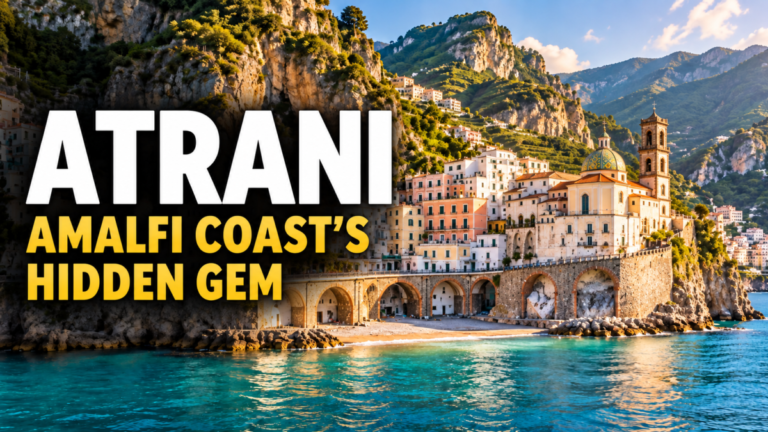
If you would rather explore another village, nearby Atrani can be reached using the pedestrian connections between the two centres. The change in atmosphere makes them an appealing combination for a day trip.
Towards evening, a waterfront stroll and a final look at the square round off the visit. If returning by ferry, plan your afternoon around the last suitable departure.
Traditions and Events: Saint Andrew and Amalfi’s Maritime Heritage
Amalfi’s relationship with Saint Andrew remains a living part of its identity. The main celebrations take place on 27 June, the feast of his patronage, and 30 November, his liturgical feast day.
Religious ceremonies and community traditions offer visitors an opportunity to experience the town through the participation of its residents. Source: Visit Amalfi, Feast of Saint Andrew.
The heritage of the four maritime cities is also celebrated through the Historical Regatta of the Ancient Maritime Republics. To attend, check the dates and host city for the relevant edition.
How to Reach Amalfi from Villa Amalia
Villa Amalia is located in Cava de’ Tirreni, a base from which to plan a day trip using connections by sea or land. Source: Amalfi Coast Resort, Contacts and Location.
By Ferry from Salerno or Vietri sul Mare
One particularly enjoyable option is to reach a departure point in Salerno or Vietri sul Mare and continue to Amalfi by ferry.
The journey reveals a succession of headlands, villages and agricultural terraces from the perspective that served for centuries as the coast’s main approach. In Amalfi, you arrive close to the centre, ready to begin exploring on foot.
Before travelling, confirm the exact departure pier, services operating on your chosen date and the last return sailing. Frequencies and journey times depend on the service, while sea and weather conditions may cause changes. Source: Travelmar, Timetables and Connections.
By Car or Private Transfer
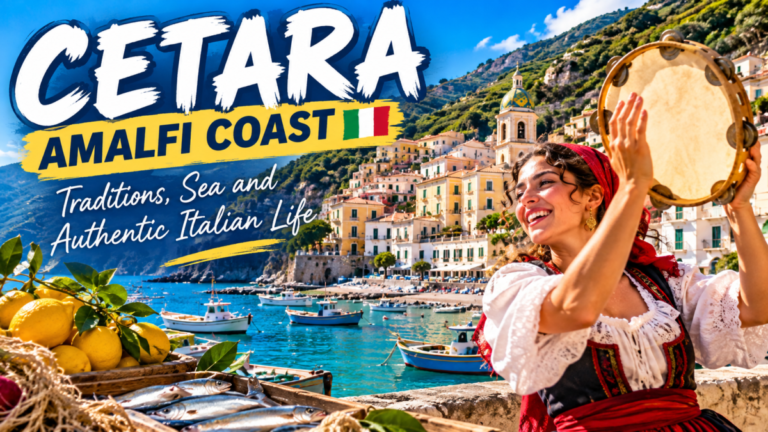
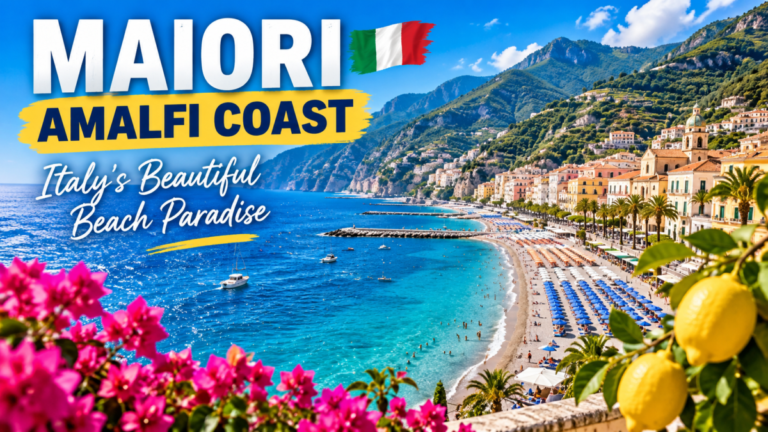
The coastal route leads from Cava de’ Tirreni towards Vietri sul Mare, then follows the SS163, passing Cetara, Maiori, Minori and Atrani.
This scenic road has bends and narrow sections. Traffic can substantially increase journey times, so leave early and check parking arrangements and any driving restrictions before setting off.
A private transfer with a prearranged return can be convenient, particularly if you would like to stay for dinner.
By Public Transport
Another option is to reach Vietri sul Mare or Salerno and take the SITA Sud 5120 Salerno–Maiori–Amalfi bus. Coordinate the first stage from Villa Amalia with coastal bus departures, allowing for possible waits and busy services. Source: SITA Sud, Route 5120.
Amalfi does not have a railway station in the town centre. The station named “Vietri sul Mare–Amalfi” is in Vietri; from there, you must continue to Amalfi by another means of transport.
When to Visit Amalfi
Spring and early autumn are worth considering for a visit combining monuments and walks. In summer, the sea takes centre stage, alongside larger visitor numbers. Booking selected services and setting off early can help you make the most of the day.
Winter offers a different atmosphere, appealing to visitors interested in the town’s cultural heritage and everyday life. During this period, checking opening times, transport connections and weather conditions is especially useful.
Whatever the season, Amalfi deserves time to be explored on foot. Beyond its best-known monuments, following an alleyway, listening to water in the valley or pausing beside the sea reveals the connections that shaped its history.
During a stay at Villa Amalia, a day here offers the chance to discover the town that gave the Amalfi Coast its name: small in scale, with a past that reaches across the Mediterranean.